Bluetooth Mesh
What is Bluetooth Mesh?
|
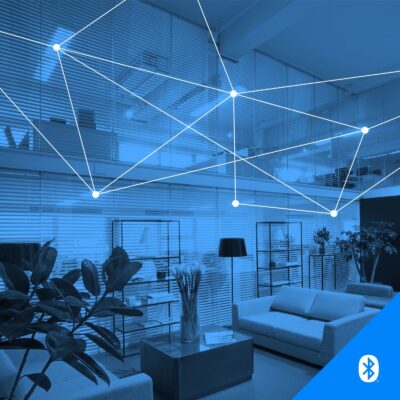
Bluetooth Mesh is a mesh network technology designed to enable communication between multiple connected devices in a distributed system. Unlike classic Bluetooth, which operates in a star topology, Bluetooth Mesh adopts a meshed architecture where each node relays information throughout the interconnected network. This design ensures seamless data transmission with no single point of failure. The technology relies on a controlled flooding model that guarantees wide coverage and secure communication between network elements. It is widely used in smart buildings, connected lighting, automated systems, and other IoT solutions. |
Bluetooth Mesh vs. Zigbee vs. Thread

|

|

|
|
|
|---|---|---|---|---|
Criteria |
Bluetooth Mesh |
Zigbee |
Thread |
Wi-Fi |
Topology |
Mesh network |
Mesh network |
Mesh network |
Star network |
Range |
Extended via relay nodes |
Medium |
Medium |
Limited without repeaters |
Energy consumption |
Very low (BLE) |
Low |
Medium |
High |
Interoperability |
Bluetooth compatible |
Requires gateway |
Supports Matter |
Varies by standard |
Security |
AES-CCM, key management |
AES-CCM |
AES-CCM |
WPA2/WPA3 |
Applications |
Lighting, access control, sensors |
Home automation, sensors |
Smart home (Matter) |
Internet, video surveillance |
Why choose Bluetooth Mesh?
Bluetooth Mesh stands out for:
Low energy consumption: optimised for autonomous connected devices.
Compatibility with existing Bluetooth systems, easing integration.
Robust and secure network: no external gateway required.
Self-forming and self-healing: maintains connections even if a node fails.
Applications in Smart Buildings
Bluetooth Mesh is well-suited to smart infrastructures:
Lighting management: unified, wireless control of all luminaires in a building.
Access control: advanced cryptographic key management for doors and control devices.
Environmental monitoring: automatic adjustment of temperature, humidity, and air quality.
Energy optimisation: seamless integration with HVAC management systems.
Security
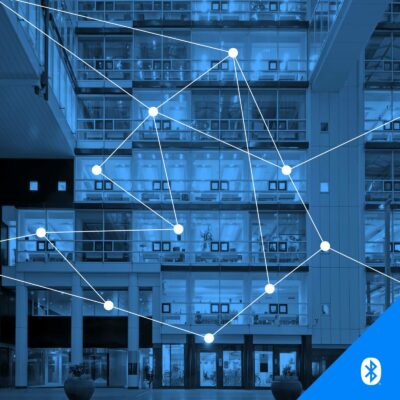
Security is a key element of mesh networks used in building automation. Bluetooth Mesh integrates advanced protocols to protect communications:
AES-CCM 128-bit encryption to guarantee data integrity.
Strong device authentication to prevent unauthorized intrusion.
Cryptographic key management to prevent man-in-the-middle attacks.
Network address security to prevent node identity spoofing.
Benefits for the End User
Bluetooth Mesh significantly improves the user experience:
Intuitive interface: compatibility with standard Bluetooth devices eases adoption.
Cost-effective installation: no cabling reduces integration and maintenance costs.
Extended battery life: devices can remain active for several years.
Flexible device management: remote customisation of operating scenarios.
Advanced cybersecurity: encrypted data to prevent intrusion.
Smart building integration: control lighting, sensors, and secured access via a mobile app.
Benefits for Designers and Manufacturers
Bluetooth Mesh offers significant advantages for IoT solution developers and manufacturers:
Low energy consumption: BLE-compatible, enabling efficient battery management.
Advanced security: robust cryptographic protocols ensuring communication privacy.
Self-forming and self-healing network: connections maintained even when a node fails.
Simplified interoperability: possible integration with Wi-Fi and Zigbee systems via a dedicated gateway.
Bluetooth Mesh and Smart Lighting
Bluetooth Mesh is particularly well suited to smart lighting systems:
Instant control of luminaires via a mobile app, without a gateway.
Scalable management: add devices without modifying existing installation.
Energy optimisation through adaptive lighting automation based on occupancy and ambient light levels.
High security with advanced data encryption.
Bluetooth Mesh and Smart Heating
This solution adapts perfectly to smart heating systems — electric radiators, heat pumps, air conditioners, or water heaters:
Precise, real-time control of radiators and thermostats via mobile app.
Scalable management: easily add equipment without changing existing installation.
Energy optimisation through automatic temperature regulation based on occupancy and ambient conditions.
Advanced security with strong data encryption.
Demand-response ready: compatible with energy provider services to reduce electricity bills.
Network Architecture
Topology
In a Bluetooth Mesh network, each device can relay messages, creating a mesh structure. This topology extends the network range since messages can “hop” from node to node until they reach their destination.
Node Types
Relay nodes: retransmit messages to extend network range.
Low Power Nodes (LPN): designed to save energy, they spend most of their time in sleep mode.
Friend nodes: help LPNs by storing messages while they sleep.
Proxy nodes: act as intermediaries between the mesh network and external devices such as smartphones.
Addressing
Unicast: addressed to a single node.
Group: addressed to a group of nodes.
Broadcast: sent to all nodes in the network.
References
Glossary
- Provisioning
The provisioning operation in a Bluetooth Mesh network is the process by which a new device is added to the network and configured to work with other devices:
Invitation: a device already in the network (the “provisioner”) invites a new unprovisioned device to join, typically via a mobile app.
Key exchange: the provisioner and the new device exchange security keys, enabling the device to encrypt and decrypt network messages.
Address assignment: the provisioner assigns a unique address to the new device for identification and targeted messaging.
Network parameter configuration: security keys, subnet information, and other parameters are configured on the new device.
- Deprovisioning
The deprovisioning (or reset) process removes a device from the network, wiping all its configuration and security keys:
Initiation: triggered by a network administrator or the device itself via a management app.
Key deletion: all security keys and network configuration data are erased.
Parameter reset: the device is reset to factory settings.
Re-provisioning: the device is then ready to be added to a new or the same network via a fresh provisioning process.
- SAD
Static Authentication Data — information used during provisioning to authenticate a new device before it joins the network. It prevents unauthorised devices from connecting by verifying identity through unique identifiers or public keys.
- Proxy Node
A proxy node acts as an intermediary between the Bluetooth Mesh network and external devices (e.g. smartphones). It translates messages between the mesh format and the format understood by external devices, allowing them to interact with the mesh without joining it.
- Relay Node
A relay node retransmits received messages to extend network range. When a message cannot reach its destination directly due to distance or obstacles, relay nodes forward it hop by hop until it arrives.
- Low Power Node
A Low Power Node (LPN) is optimised for minimal energy consumption, ideal for battery-powered or energy-harvesting devices:
Spends most of its time in sleep mode.
Wakes periodically to check for messages.
Pairs with a Friend Node that stores incoming messages while the LPN sleeps.
- Friend Node
A Friend Node assists Low Power Nodes (LPNs) by storing messages addressed to them while they sleep:
Receives and buffers messages intended for its paired LPN.
Delivers stored messages when the LPN wakes up.
- Unicast Address
A unique address assigned to a single node in the network. Messages sent to a unicast address are processed only by that specific node. Used for point-to-point communication.
- Group Address
An address targeting multiple nodes simultaneously. Used for group commands where several devices must react identically — for example, switching all lights in a room.
- Element
To be completed.
- Message
To be completed.
- Publish/Subscribe
To be completed.
- Model
To be completed.
- Generic
To be completed.
- Scene
To be completed.
- Energy Harvesting
To be completed.
Revision date: Oct 13, 2026